Showing posts with label Alexa Levitz. Show all posts

Monday, April 2, 2012

Are the Hunger Games really a game?

(WARNING: spoiler for those who have not completed the book!)

After finishing the book The Hunger Games, I was astonished that the competition of the Hunger Games could be considered a game. The ruthless fighting and quest for survival between the 24 tributes seemed more like a war than a game. But as I reflected on this course, I realized that the games, in fact, did fit many criteria to be considered a game despite how it seemed trivial for me to call a fight to death a “game”.

Throughout the semester, we have discussed many of the different characteristics of games. One of the main characteristics is that participation is voluntary. However, participation in this game is far from voluntary. The 24 tributes are selected by a lottery to participate.  When Prim was the girl selected from District 12, her older sister, Katniss, volunteers herself as tribute, knowing that she has a better chance at survival than her younger sister. While in this sense, Katniss’s participation was voluntary; it was only as sacrifice for her sister. She would rather die than watch her younger sister get killed in the competition. She did not want to participate. Simply, it was the only alternative she had if she did not want to watch her sister die.

Another characteristic of games is that they involve strategy. The Hunger Games indeed required strategy by the participants. Haymitch told Katniss and Peeta to use their talents to their advantage and carefully observe the other tributes’ talents, so they know what to expect. Katniss uses her hunting and outdoor skills, and Peeta uses his tremendous strength. Further, during the competition Katniss and Peeta act like star-crossed lovers in order to gain favor with the audience, another strategy. By gaining audience support, they have a better chance of obtaining gifts, like water, food, medicine and tools, necessary for their survival. During the Hunger Games, each participant allies with various people, as a strategy to avoid the other tributes teaming up. When there was a twist in the rules of the game, and a team of tributes was allowed to win, Peeta and Katniss use the star-crossed lover ploy even more to their advantage. They use this strategy to obtain audience support through the love-scheme, but also to aide each other, in hopes of helping the other survive. Whether or not Katniss and Peeta are truly in love is not fully clear; yet, it is clear that the two District 12 tributes strategize and work together to win the Hunger Games. However, these individual strategic tactics employed by Katniss and Peeta do not necessarily mean that the game is all strategy. The game is controlled by the Capitol, and represents governmental control over the 12 districts. The Gamemakers force tributes to participate and can change rules at any time, adding twists and turns, leaving only so much room for individual strategy.

While the prior aspects are controversial as to whether the Hunger Games should actually be considered a game, this competition does fit one game criterion flawlessly. If anything, the arena in which the members of each district fight to win is the perfect representation of the “magic circle”.  The Hunger Games is set in a specific place for a specific date and duration. The Game takes place in a computer-made outdoor arena beginning on a set day each year and lasts until there is only one survivor. In this light, the Hunger Games is its own “magic circle”, and in this way can be considered a game.

In another sense, the Hunger Games are a form of entertainment for the citizens of Panem, particularly the Capitol. Although family and friends of the tributes do not find it entertaining to watch their loved ones struggle, many of the citizens do find the games quite entertaining. It is broadcast to all 12 districts 24 hours a day. The Capitol finds the struggle amusing to watch. While the original intent of the games is to remind the districts not to rebel, it does provide a source of entertainment. In fact, one reason Katniss and Peeta continued their love during the competition was because it provided entertainment for the audience, as the “love story” could indeed help them win over the audience’s support. Further, the Capitol reverted to the old rules, at the end, so there could only be one winner because it would be more entertaining for the audience to see these star-crossed lovers fight for survival. However, when the two of them were about to commit suicide, the Capitol changed the rules yet again since it would be more entertaining to have two winners than none.

Hunger Games as a “game” summary:
Participation is voluntary: NO (well, in Katniss’s case yes—but not really!)
Involves strategy: YES to an extent, but also NO (the Capitol can alter the rules at any time, to create an outcome that they desire)
Is played in a “magic circle”: YES
Is a form of entertainment: YES, but NO (in terms of for family and friends of tributes, who must watch their loved ones struggle in what is essentially a death sentence)

With this, it is clear that the Hunger Games does not perfectly fit the definition of a game. The Hunger Games fit some criteria, and not others. This leaves it up to the discretion of each reader to determine whether or not they believe these games fit the definition of a game. Since the word game is in the title of the competition, readers may have the false belief that the competition is a game. But as previously discussed, I believe it is trivial for the Hunger Games competition to be considered a game, especially since there is not one specific definition for a game. 

Do you think the Hunger Games are a game?

Friday, March 23, 2012

Learning and Play: An adventure to the Hands on Museum

Learning is fun!

Whenever someone used to tell me this I would look at them like they were crazy. How could learning be fun? Until college, where I began being able to take classes that I actually enjoyed, I thought learning was far from fun. Learning meant one thing for me. Learning mean school. School meant days full of lengthy classes, which bore me. Thus, by the transitive property (yes, this was one thing I did take away from that boring geometry class back in 9th grade…) learning meant boredom!

But then I began college. And learning began to take on a new meaning for me. I took classes that interested me with professors who were so engaging that I actually looked forward to class for the first time in my life. I encountered new forms of learning: interactive learning.

Outside the museum
For Minor Quest #3, the only thing we were given was: UTM 17T 272566 4684679. We had to determine what this code meant and any further steps. Figuring out what this code meant was like a game for me. It was something fun, a puzzle. After figuring out that these numbers and letters correlated to the Hands on Museum in Ann Arbor, my friend and I decided to go see what this museum was.


When we walked in, the first thing I saw was a sign that said, “Discover the scientist within you”. This museum was an interactive children’s museum—a fun way for kids to learn. Children can learn about scientific concepts though the various hands on exhibits and activities. The Visitor Guide says, “Discover the scientist within you as you experiment by pushing, pulling, twisting, touching, shaping, building and turning. Get ready to have fun as you embark on a science adventure!” According to Susan Gelman, a psychology professor at the University of Michigan, play is a fundamental activity during childhood in all cultures. Play takes many forms: parallel play (when kids are next to each other playing but do not actually interact), traditional games, sports, board games and role-play. While “pushing, pulling, twisting, touching, shaping, building and turning” activities are not the types of games Gelman talks about, I could consider this museum a new, modern form of a game. Children at the museum participate in an engaging, fun form of play.
An exhibit on health & balance

Even as a college student, I found myself engaged in the activities intended for preschoolers and elementary-age kids. In fact, I found myself as engaged in these activities as I am when I play games intended for my age, like sports. As I explored each of the exhibits, I found myself having fun in a way I never imagined I could as a nineteen year old. Each exhibit was not only a game, but also had information about some concept. Some of these facts were completely new to me, even as a college student.

Taylor at the Health Exhibit
What we thought would be a quick trip to the museum simply to figure out why this museum was the place we were supposed to go for the quest, we spent over an hour there having a blast. I felt as if I was a young child again, drawn to these extraordinary stimuli. Each exhibit was bright and attractive, full of information in an easy to comprehend manner. As I progressed through the museum, I remained interested and attentive to each exhibit. In my opinion, the main reason for this was the hands-on nature of the museum.

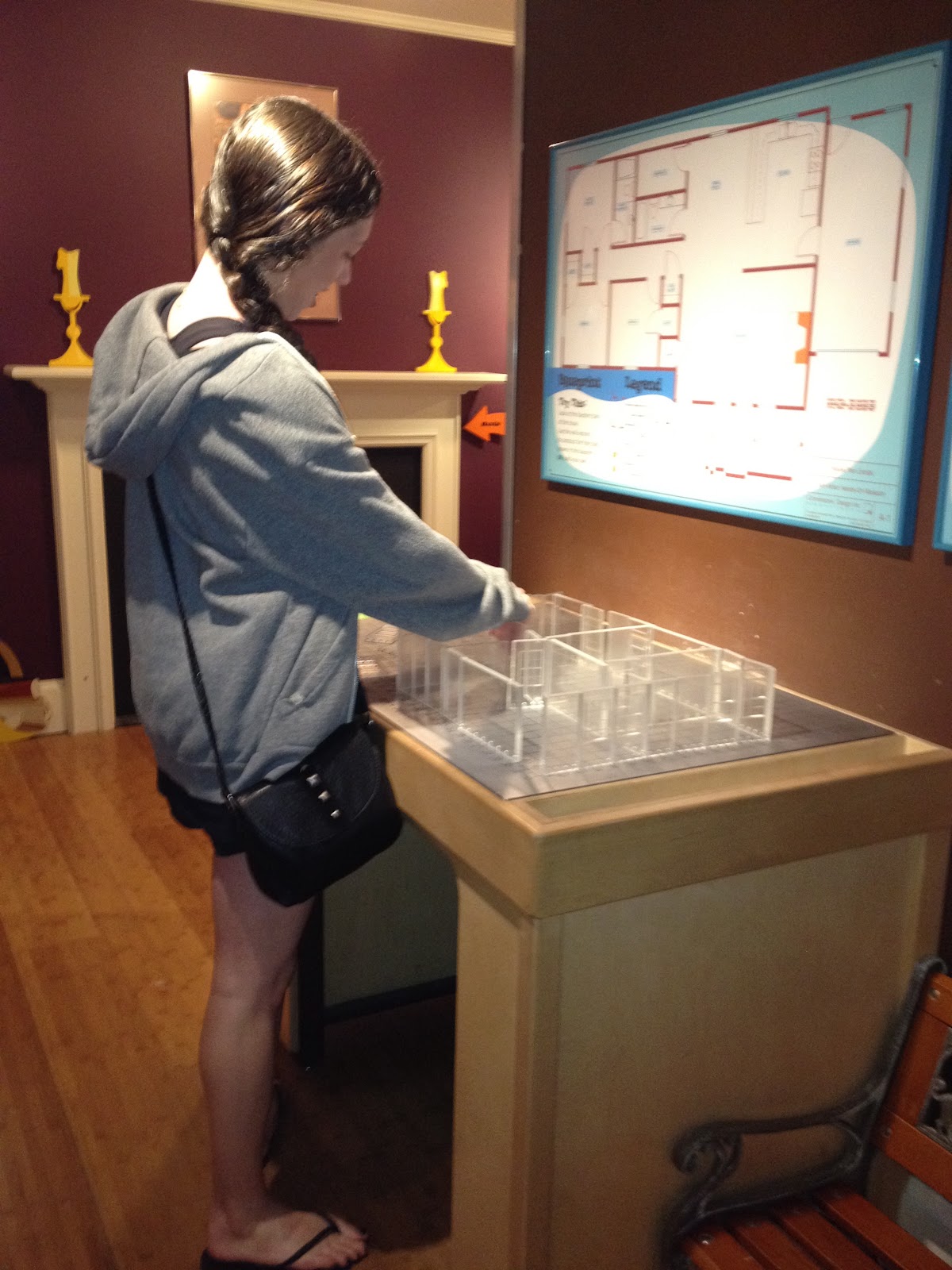
Me at the Architecture Exhibit
Usually, I get extremely bored at museums. As a child I would dread when my grandparents wanted to take me to the Art Institute in Chicago or the Field Museum. All I wanted to do was have fun, but at these museums I had to be quiet and careful not to touch anything. However, at this museum, the whole point was to interact with the various exhibits as a form of learning. This made the learning fun and informative. Since I could interact and play with the different exhibits, I felt as if the exhibits were types of games. This kept me engaged in learning because I was not simply reading information or observing various displays. Instead, I was able to create fun out of learning. While I was technically doing a homework assignment at the museum, I really felt the enjoyment I felt as a child in playing games. With games, like the ones I played in the museum, I was explicitly learning but also playing and enjoying the learning at the same time.

Taylor in the Building Block Exhibit
In our society today, parents, teachers, kids and many other influential individuals so greatly stress the importance of education that children are limited in their playtime. According to Melinda Wenner, in the article The Serious Need for Play, “Starting them as early as preschool, parents concerned about getting their kids into the right colleges are filling after-school hours with music lessons and sports—reducing time for the type of imaginative and rambunctious cavorting that fosters creativity and cooperation,” (Werner, 24).  This museum is a concrete bridge between play and education. It incorporates play within learning about things such as the planets, health and fitness, bone structure, physical properties of the earth, light and many more. These game-like exhibits help children learn, while also providing them with the freedom to approach the exhibits in any way they desire, making them both fun and educational.

With this, I realized learning really is fun!

Works Cited: 

Wenner, Melinda. (2009). The Serious Need for Play. Scientific Americans Mind, February/March, 22-29. Retrieved from www.SciAmMind.com.
Gelman, Susan. Fun and Games in Childhood. UC 256. The University of Michigan, Ann Arbor, MI. 22 February 2012. Lecture.


Tuesday, February 21, 2012

Class Competition

After reading Sarah’s blog post “A Counter Example to the N-effect”, I began thinking about how school is really just another form of a game. Students compete with themselves, classmates, friends, siblings, and many other people to be able to get the best grades. The goal of getting good grades can be short or long term. Short term some goals may be to be on the honor role, to feel like your hard work paid off or to prove to someone else your intelligence. More long-term goals related to getting good grades include: getting into college, getting into graduate school or getting the job offer you want.
My competitive drive in school to receive good grades results from internal motivation to do the best I possibly can so that I have enabled myself to have the best possible opportunity to get the job I want out of graduate school. In terms of school work, I am hard on myself to reach my full potential, but I also feel competitive with other students when there are a limited number of top grades—such as when a class is graded on a curved scale. Particularly in big lectures, where I am not sure how a professor will grade a test, paper or other type of assignment, I feel the most competitive. I do not know the academic abilities of the hundreds of other students in that big class. However, in a smaller class or discussion I have a better idea of where I rank among the other students. Further, with a smaller class size, it is easier to build a relationship with the professor in the classroom situation. You are able to get a better sense of they will grade and the types of skills that are most important to them.
This idea about class size reminded me of a topic covered in my Psychology 250 (Developmental Psychology) class taught by Doctor Christopher Monk. In this class, we learned about a study on what makes a school effective. The results demonstrated that kids (from Kindergarten- 3rd grade) in smaller class sizes had greater achievement in later grades, and were more likely to graduate. The reason behind this was determined to be that teachers of smaller classes spend the most amount of time giving individual attention to students, in turn providing the most effective teaching atmosphere for each student.
With this information, I came to the conclusion that the reason I felt the most competitive in larger classes was the information and way it is presented is less personally tailored to the ways in which I learn best. However, in a smaller class, whether or not the professor specifically tailors the information, it is easier to build a close-knit relationship with them and get the most out of learning. In a big lecture, the way a professor teaches may be more beneficial for other students than me, and so I feel more competitive to work harder to still receive the grade I want in the class.
However, Stephen Garcia’s idea of the N-effect claims that increasing the number of competitors decreases competition among competitors. In order to determine if other people also felt the opposite of the N-effect, I decided to conduct a survey that I posted to my Facebook and emailed to various college students. I found that I was indeed in the minority who felt this way about large classes.  The results were as follow:


The results paralleled Garcia’s findings with the N-effect. People felt most competitive with their friends—people who are very close in social-relation orientation—aside from feeling competitive to beat their personal best. They also felt most competitive in a small class, discussion or seminar. While these results were consisted with the N-effect, I hope to further explore why I feel so differently.

Wednesday, February 15, 2012

"Runner's High"


This morning, as I slowed down my speed on the treadmill from running to a walking pace, I looked at the screen in front of me. One hour, eight minutes. For a moment, I thought to myself—what was I doing that whole time? 


Running, yes. Exhausted, no. Sweating, yes. Thinking, no. 

And then I realized what I was doing. I was in a state of flow. According to Mihaly Csikszentmihalyi, flow is a state of awe and bliss, which results from a person being intensely involved in what they are doing. Csikszentmihalyi, in his video “On Flow”, describes a musician in the state of flow: ecstatic to a point where he felt as if he almost didn’t exist. He claims that flow comes from something that requires a high level of challenge but also a high level of skill.  Well, running is very challenging for me, but I also am a skilled runner. I’ve known I was a talented runner since I was in elementary school and won the 50 yard dash during Field Day (our school-wide “Olympic” competition), since I was a 6th grader in middle school and the coach put me on the 8th grade track team, since I was a member of my high school track team’s 4x200 relay team that set the school record.

My teammate and I in the 4x200 race
when we set the school record


I do have a lot of skill when it comes to sprinting, but running longer distances is much more of a challenge for me, especially after breaking my leg and foot within a year of each other. Putting these different ideas together, I determined that what I had always considered to be a “runner’s high” was really a state of flow. I was doing something that was challenging, but I was qualified to take on. During my run, I had lost track of time and had no idea what I was thinking about, characteristics of someone in a state of flow. All I knew was that when I began my run, in my head I was singing along to my music but by the end my head was no where—not paying attention to my music, not paying attention to how hot I was, and not paying attention to the time. Rather, I was fully absorbed in my run. I was so focused on my run that I did not even realize just how focused I was, but as I began to cool down, I realized this run was the perfect example of flow.

Monday, February 13, 2012

Disidentification


Last summer I volunteered at Beyond Sports Foundation as a mentor and tutor for athletically gifted, low-income high school athletes, from the inner city of Chicago.  The goal of the foundation is provide academic and social tutoring to these students, in order to obtain NCAA scholarships, their only avenue into college.


One of the BSF students and a tutor at the
Graduation Party for the Class of 2011 (in June)
I was home from school this past weekend, and while I was home I decided to go visit the students I had worked with. As I was talking to the boys, I asked them how school was, and I asked the seniors where they decided to go to college. One of the boys, who I spent a great deal of time working with this summer, told me he had not yet decided. At first I was very confused. The National Signing Date for a National Letter of Intent for football was February 1st, and most of the boys in the foundation had immediately committed. As we continued talking, he told me that he decided not to play football in college because the schools he was looking to sign with were not as good academically as schools he could get into based on his grades. 


Instantly, I thought about Claude Steele’s idea of “disidentification”, in the article Race and the Schooling of Black Americans.  I found it noteworthy that the one white student in the foundation was the one student in the foundation who still felt some connection to the academics of school. In the article, Steele talks about disidentification as the lack of a process in which Black students identify with school and academic achievements, resulting from the double vulnerability of Black students in school, where they risk confirming academic incompetence, thus the racial inferiority they are suspected of. As a result of this extreme pressure, at the first encounter with a modest academic setback, the Black students disidentify with academics and identify with something different to help boost their self-esteem (Steele, 1992). Steele claims the disidentification process only happens with black students, and this situation seemed to support his belief. 


While the 4 other seniors in the foundation, all Black, clung to their sports as the source of their identity and their path to college, this one White student believed academic success was more important than athletic success. The 4 other students used their athletic success as a way for them to succeed, but this one realized that doing well in school would get him farther in life. Academic success could help him get a career in which he could support himself and eventually a family, giving them the life he never had. He recognized his talent was above most other high school athletes, but not enough to go beyond college and provide economic security. He believed getting the best academic education possible would help him in the future, even if that meant giving up an NCAA athletic scholarship and finding other ways to pay for college. 


Some of the BSF students and tutors hard at work
This situation also reminded me of the “Star Power” game because in an attempt to get the best education, this one kid is trying to achieve something very difficult for someone in the lower class of our economically stratified country. He wants to reach a higher level of economic success than the one he was born into. However, the constraints that a low-income placed on his chance to go to college make it very hard to do so and easy to chose another path, such as athletics. 

Friday, February 10, 2012

Pistons vs. Heat Basketball Game


On January 25th, Brooke and I attended the Detroit Pistons vs. Miami Heat basketball game. The score at the end of the first half was 56-50, Miami. However, in the third quarter, each team scored the same amount of points, making the score at the end of the third, 80-74. In the fourth quarter, the Pistons scored more than the Heat, yet not enough to bring home the win. The final score was 101-98, Miami. Within the length of the game, we witnessed the talent of some of the top players in the NBA, as well as the newest recruit for the Pistons, 20-year-old Brandon Knight. According to Huizinga in Homo Ludens, “Play begins, and then at a certain moment it is ‘over’” (9). In just four twelve-minute quarters, we witnessed countless plays, turnovers, rebounds, and even dunks. However, as the buzzer sounded at the end of the fourth quarter, the game ended as quickly as it started. Although people spent hours talking about the game before it began and after it was over, the actual play only occurred from the moment it started to the moment it ended. In addition to the fact that the game was set for a pre-determined time, the game was also in a distinct setting—The Palace of Auburn Hills. As we discussed in class, having a distinct setting is another feature of game play.


Going into the game, the Pistons had lost twelve of their last fourteen games. Despite this rough patch, they always had each other to depend on in order to maintain their positive attitude. Compared to the Heat, who made it to the championship in 2011 and are ranked first in the Southeast Conference, the Pistons are one of the weakest teams in the NBA. For this reason, the Pistons did not have much to lose if they did not win. Thus, when the game started, the competition level was very low. The Pistons would not be as upset losing to the Heat as they would be losing to a team such as the Cleveland Cavilers, who are only ranked one spot ahead of them in the Central Conference. According to the article, Ranks and Rivals: A Theory of Competition by Stephen Garcia, competition is at its greatest level when you compare two counterparts of similar capability. Since the two teams had such different rankings, there was not much competition when the game began. However, as the game went on, in the fourth quarter the score became very close. This generated more competition because the Piston’s chance of winning was now within reach. In the end, the Heat did win by three points. However, Garcia would assert that the Pistons would have accepted the loss much more easily if they had lost by a greater amount of points. This disappointment is a result of the Social Comparison Theory.
NBA Basketball is very competitive because it is both a popular form of entertainment for the public and also a form of income for the players. Huizinga states:
“Play is superfluous. The need for it is only urgent to the extent that the enjoyment of it makes it a need. Play can be deferred or suspended at any time… It is never a task. It is done at leisure, during ‘free time’” (13).
We do not believe that professional basketball meets these terms for what is considered to be play. A NBA game cannot be suspended at any time because the schedules have been set months in advance. Further, playing basketball for the NBA is a career for the players. This makes it a form of a task, rather than a recreational activity done during their “free time”. This is not to say that the players do not enjoy playing the sport, as most have dreamed of playing professional basketball since they were just toddlers. However, professional basketball includes more than just a recreational aspect, as it is also the way in which the players earn their salary. Thus, as an official career, the players must obey the rules of their contract. With this being said, the game of basketball is not completely leisure because there are certain regulations that both the players and coaches must follow. Basketball as a form of play goes beyond pure recreation. It is recreation for us as fans but not necessarily for the players, coaches and other team members. They are judged based upon their performance and must uphold a positive image.
Basketball is a team sport. Therefore, even after the buzzer sounds to officially terminate the game, the players must continue to work together. They are a team even after they leave the court. Although the game is over, their commitment to each other is not. Their relationships must carry on from one game to the next. Huizinga in Homo Ludens writes, "A play-community generally tends to become permanent even after the game is over" (12). Both the Pistons and Heat players remain “apart together”, a term coined by Huizinga. The players on each team are teammates for the entire season, both on and off the court. They are distinct from other teams and the rest of the world because they have a special membership in their team. In a way, they are like a family. Simply because of their mutual commitment to the team, they have an everlasting commitment to each other.


Works Cited