Whenever someone used to tell me this I would
look at them like they were crazy. How could learning be fun? Until college, where I began being able to take
classes that I actually enjoyed, I thought learning was far from fun. Learning
meant one thing for me. Learning mean school. School meant days full of lengthy
classes, which bore me. Thus, by the transitive property (yes, this was one
thing I did take away from that boring geometry class back in 9th
grade…) learning meant boredom!
But then I began college. And learning began
to take on a new meaning for me. I took classes that interested me with
professors who were so engaging that I actually looked forward to class for the
first time in my life. I encountered new forms of learning: interactive
learning.
 |
| Outside the museum |
For Minor Quest #3, the only thing we were
given was: UTM 17T 272566 4684679. We had to determine what this code meant and
any further steps. Figuring out what this code meant was like a game for me. It
was something fun, a puzzle. After figuring out that these numbers and letters
correlated to the Hands on Museum in Ann Arbor, my friend and I decided to go
see what this museum was.


When we walked in, the first thing I saw was
a sign that said, “Discover the scientist within you”. This museum was an
interactive children’s museum—a fun way for kids to learn. Children can learn
about scientific concepts though the various hands on exhibits and activities.
The Visitor Guide says, “Discover the scientist within you as you experiment by
pushing, pulling, twisting, touching, shaping, building and turning. Get ready
to have fun as you embark on a science adventure!” According to Susan Gelman, a psychology professor at the University of Michigan, play is a fundamental activity during
childhood in all cultures. Play takes many forms: parallel play (when kids are
next to each other playing but do not actually interact), traditional games,
sports, board games and role-play. While “pushing, pulling, twisting, touching,
shaping, building and turning” activities are not the types of games Gelman
talks about, I could consider this museum a new, modern form of a game.
Children at the museum participate in an engaging, fun form of play.
 |
| An exhibit on health & balance |
Even as a college student, I found myself
engaged in the activities intended for preschoolers and elementary-age kids. In
fact, I found myself as engaged in these activities as I am when I play games
intended for my age, like sports. As I explored each of the exhibits, I found
myself having fun in a way I never imagined I could as a nineteen year old.
Each exhibit was not only a game, but also had information about some concept.
Some of these facts were completely new to me, even as a college student.
 |
| Taylor at the Health Exhibit |
What we thought would be a quick trip to the
museum simply to figure out why this museum was the place we were supposed to
go for the quest, we spent over an hour there having a blast. I felt as if I
was a young child again, drawn to these extraordinary stimuli. Each exhibit was
bright and attractive, full of information in an easy to comprehend manner. As
I progressed through the museum, I remained interested and attentive to each
exhibit. In my opinion, the main reason for this was the hands-on nature of the
museum.
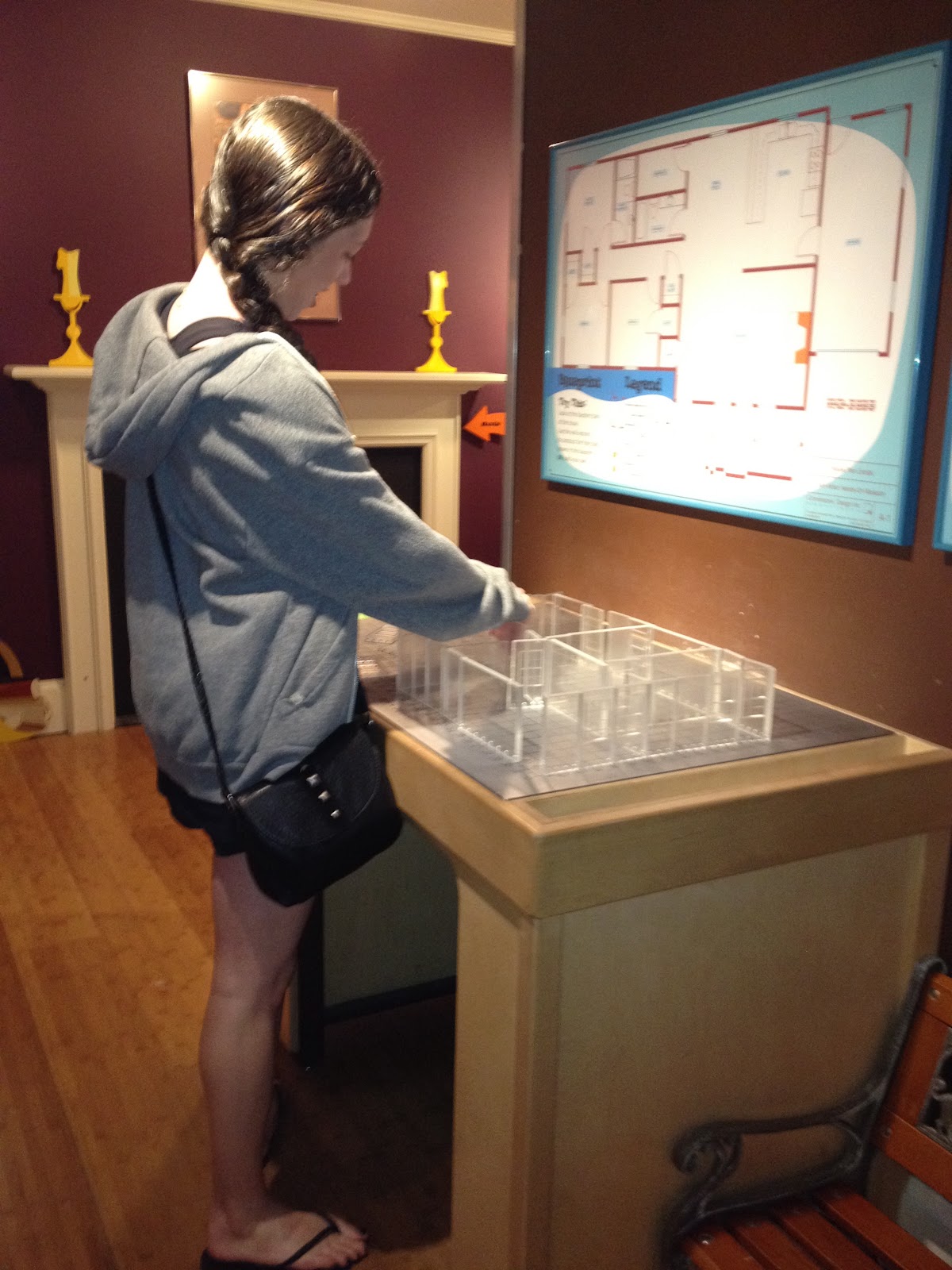 |
| Me at the Architecture Exhibit |
Usually, I get extremely bored at museums. As
a child I would dread when my grandparents wanted to take me to the Art
Institute in Chicago or the Field Museum. All I wanted to do was have fun, but
at these museums I had to be quiet and careful not to touch anything. However,
at this museum, the whole point was to interact with the various exhibits as a
form of learning. This made the learning fun and informative. Since I could
interact and play with the different exhibits, I felt as if the exhibits were
types of games. This kept me engaged in learning because I was not simply
reading information or observing various displays. Instead, I was able to
create fun out of learning. While I was technically doing a homework assignment
at the museum, I really felt the enjoyment I felt as a child in playing games.
With games, like the ones I played in the museum, I was explicitly learning but
also playing and enjoying the learning at the same time.
 |
| Taylor in the Building Block Exhibit |
In our society today, parents, teachers, kids
and many other influential individuals so greatly stress the importance of
education that children are limited in their playtime. According to Melinda Wenner, in the article The Serious Need for Play, “Starting them as early as preschool, parents concerned about getting
their kids into the right colleges are filling after-school hours with music
lessons and sports—reducing time for the type of imaginative and rambunctious
cavorting that fosters creativity and cooperation,” (Werner, 24). This museum is a concrete bridge
between play and education. It incorporates play within learning about things
such as the planets, health and fitness, bone structure, physical properties of
the earth, light and many more. These game-like exhibits help children learn,
while also providing them with the freedom to approach the exhibits in any way
they desire, making them both fun and educational.
With this, I realized learning really is fun!
Works Cited:
Wenner,
Melinda. (2009). The Serious Need for Play. Scientific
Americans Mind, February/March, 22-29. Retrieved from www.SciAmMind.com.
Gelman,
Susan. Fun and Games in Childhood. UC
256. The University of Michigan, Ann Arbor, MI. 22 February 2012. Lecture.
